Insights from cleaning thousands of camera sensors over the past 10 years.
Introduction
Camera sensor contamination is one of the most common issues photographers encounter when using interchangeable‑lens cameras.
Over the past 10 years, we have cleaned many thousands of camera sensors for photographers ranging from enthusiasts to working professionals. During that time clear patterns have emerged in terms of how contamination occurs and which photographers are most likely to experience it.
Understanding these patterns can help photographers reduce the likelihood of contamination and maintain the performance of their equipment.
What Cleaning Thousands of Sensors Reveals
Real‑world experience cleaning thousands of sensors reveals several consistent patterns:
- Mirrorless cameras now account for roughly 75–80% of cameras requiring cleaning.
- Cameras used with large telephoto zoom lenses tend to accumulate contamination more quickly due to internal air movement.
- Photographers working outdoors in dynamic environments encounter contamination more frequently.
- Many contamination issues arise not from the environment, but from previous cleaning attempts using unsuitable tools.
Perhaps the most important observation is that sensor contamination rarely consists of simple dust alone. In practice we regularly encounter fibres, oil deposits, environmental debris and moisture contamination.
Why Do I Have Dark Spots on My Photos?
If you notice dark spots appearing in your photographs, particularly against bright skies or plain backgrounds, the most likely cause is contamination on the camera sensor.
These spots are usually most visible when shooting at smaller apertures such as f/11, f/16 or f/22 where the shadows cast by particles on the sensor become more defined.
Why Are There Dark Spots on My Photos of the Sky?
One of the most common ways photographers discover sensor contamination is when photographing clear skies.

At smaller apertures such as f/11, f/16 or f/22, particles on the camera sensor cast small shadows that appear as dark spots in images. These spots are often easiest to see against bright or uniform backgrounds such as blue skies.
Because the contamination sits on the sensor surface, the spots usually appear in the same position across multiple photographs.
If you notice spots that remain in the same location from image to image, this is usually a strong indication that the camera sensor requires cleaning.
How to Check Your Camera Sensor for Contamination
- Set the camera to Aperture Priority mode.
- Select an aperture such as f/16 or f/22.
- Photograph a clear sky or plain white wall.
- Switch the lens to manual focus to prevent AF hunting problems.
- Review the image at 100% on screen.
If contamination is present, it will appear as dark spots in consistent locations across multiple images.
Let Cameracal Analyse Your Test Image
Once you have taken your JPEG sensor-test photograph, upload it to the Cameracal Sensor Health Check for an immediate analysis.
The application identifies and maps possible contamination, reports the number and severity of detected marks and helps you understand whether your sensor may require cleaning. The initial analysis is free, with an optional detailed £5.99 PDF report available.
Checking Sensor Contamination: Mirrorless vs DSLR Cameras
One advantage of mirrorless cameras is that it is often easier to identify sensor contamination.
Because the electronic viewfinder displays a live image directly from the sensor, stopping the lens down to f/22 will often reveal contamination immediately in the electronic viewfinder or rear display.
With DSLR cameras this is not the case. The optical viewfinder does not show the sensor itself but instead displays the image reflected through the mirror and focusing screen. Dust seen in a DSLR viewfinder is therefore usually located on the focusing screen or within the viewfinder system and is not contamination on the sensor.
To confirm contamination on a DSLR sensor it is necessary to take a test photograph at f/16–f/22 of a clear sky or plain background and inspect the resulting image on a monitor.
Mirrorless Cameras and Sensor Contamination
In recent years the majority of cameras arriving for cleaning are mirrorless models, often around 75–80% of the cameras serviced.
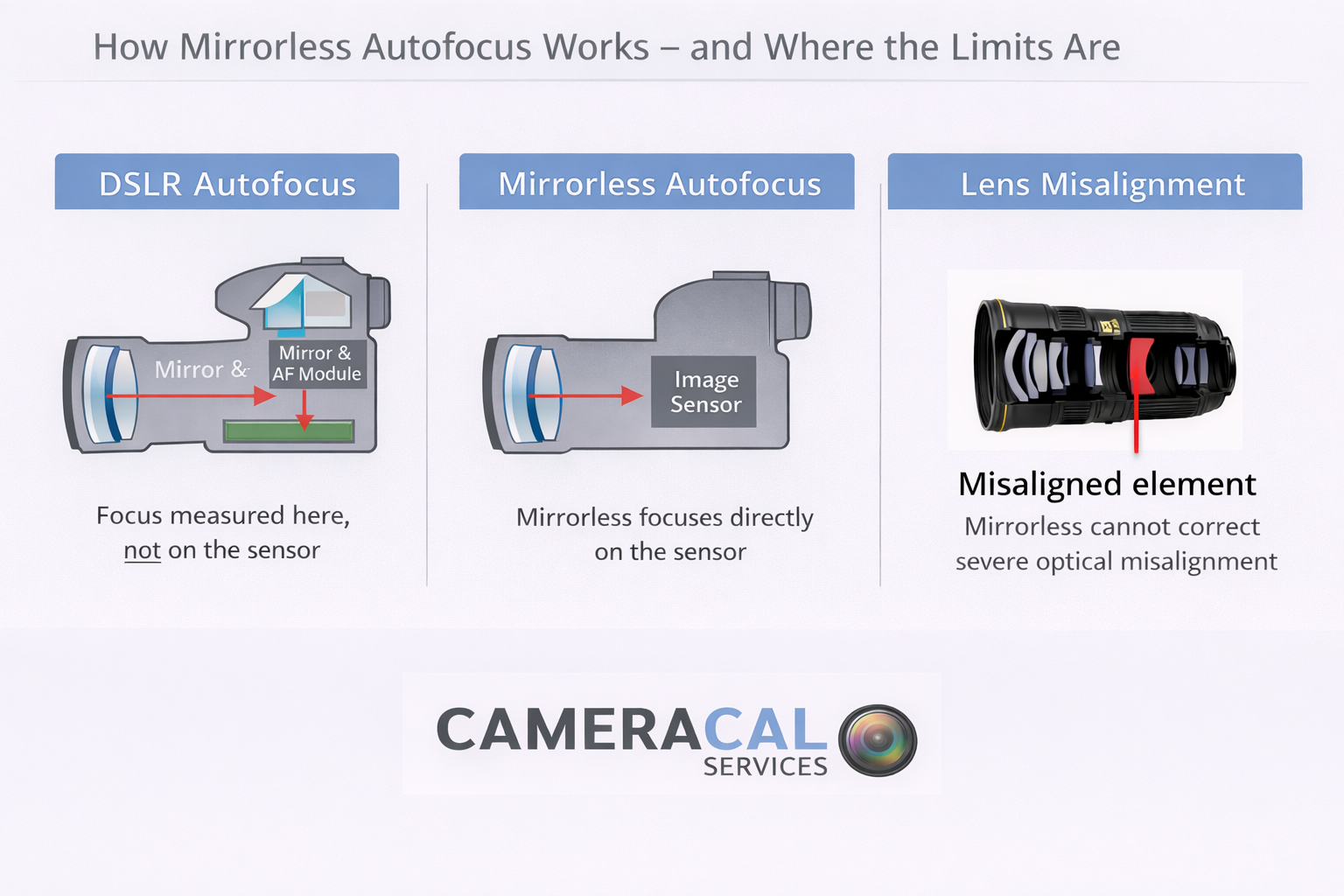
Unlike DSLR cameras, mirrorless cameras position the sensor directly behind the lens mount. This means contamination entering the camera body can reach the sensor more easily.

DSLR cameras contain a mirror box assembly, which often acts as a temporary holding area where dust and debris accumulate before eventually reaching the sensor.

The Air Pump Effect of Zoom Lenses
Zoom lenses can contribute to sensor contamination.
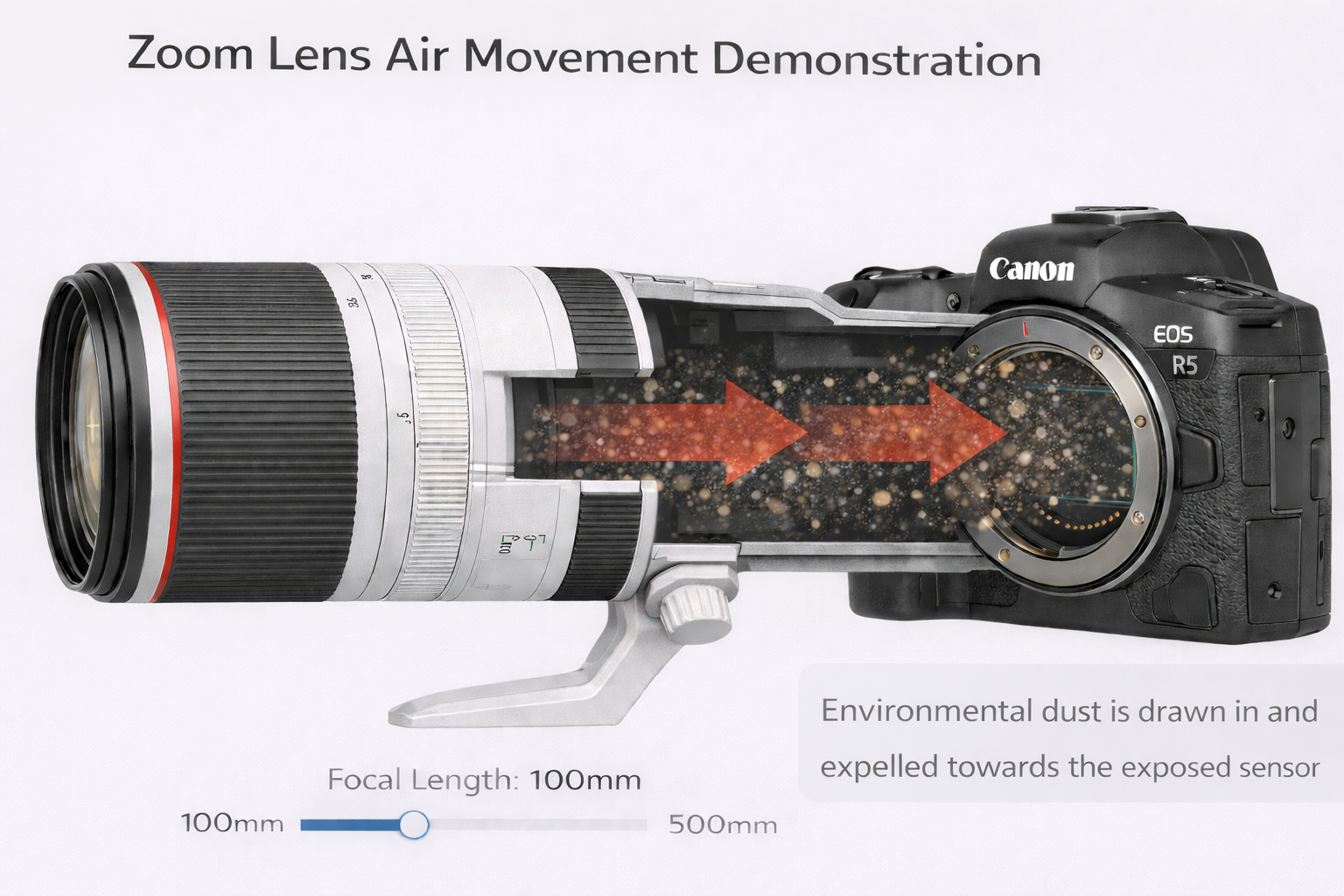
When a zoom lens is extended or retracted, it moves a significant volume of air in and out of the lens barrel. This movement can draw airborne particles toward the camera mount.
With mirrorless cameras, where the sensor sits directly behind the mount, this contamination can more easily reach the sensor. This effect is particularly noticeable with long telephoto zoom lenses.

Contamination from Rear Lens Elements
One common source of contamination is the rear element of the lens itself.
Rear lens caps often collect dust, fibres and other debris when they are stored loosely in pockets or camera bags. When a lens is placed back into the rear cap, this contamination can transfer directly onto the rear lens element.


When the lens is mounted onto the camera, these particles can then be drawn into the camera body.
Zoom lenses can further accelerate this process because extending and retracting the lens moves air in and out of the lens barrel. This movement can pull contamination toward the camera mount.

This effect is particularly noticeable with mirrorless cameras, where the sensor sits directly behind the lens mount and remains exposed during normal operation. If contamination is present on the rear lens element, particles can be drawn into the camera body during the movement of the zoom mechanism.
Because the mirrorless sensor sits so close to the lens mount, and the powered sensor assembly can develop a slight electrostatic attraction, this contamination is more likely to settle on the sensor surface.
In DSLR cameras, the sensor is normally protected behind the mirror and shutter assembly and is only exposed during the moment of exposure. As a result, contamination entering the camera body often accumulates first within the mirror box before eventually reaching the sensor.
Photographers Most Likely to Experience Sensor Contamination
From our experience cleaning thousands of cameras, certain types of photographers tend to encounter contamination more frequently.
Wildlife photographers – often working outdoors using large telephoto zoom lenses which move significant volumes of air.
Sports and aviation photographers – frequently working in environments containing dust, sand, rubber debris and grass particles while changing lenses quickly during events.
Landscape photographers – often changing lenses outdoors and shooting at smaller apertures such as f/11–f/22 where even small particles become visible.
Macro photographers – working at high magnifications and small apertures, where even tiny particles of contamination become visible.
Five Common Causes of Sensor Contamination
Most sensor contamination originates from a small number of common causes:
- Dust entering the camera during lens changes
- Contamination on rear lens elements
- Zoom lenses draw air into the camera body
- Environmental debris such as sand or fine dust
- Previous cleaning attempts using unsuitable tools
Do In‑Camera Sensor Cleaning Systems Remove Contamination?
Many modern cameras include automatic sensor cleaning systems which vibrate the sensor to dislodge loose particles.
While this can remove very light contamination, particles that have bonded to the sensor surface — such as oil or environmental debris — usually require manual cleaning techniques.
What We Actually Find on Camera Sensors
Sensor contamination often includes far more than simple dust. During professional cleaning, we commonly encounter:
- airborne dust
- fibres and hair
- environmental debris such as sand or salt
- lubricant mist
- moisture deposits
- spittle contamination
A Real‑World Example: Moisture Contamination on a Mirrorless Sensor
During a recent sensor clean on a mirrorless camera, a large circular drying mark was visible when inspecting the sensor through the electronic viewfinder. A confirmation test photograph of the sky taken at f/22 clearly showed the contamination.
Careful inspection revealed that the mark was not dust but a dried moisture deposit. When discussing the issue with the customer, it became clear that the contamination had most likely occurred while the lens was being changed, whilst talking to a colleague. The camera was switched on at the time.
With many mirrorless cameras, the sensor sits directly behind the lens mount and remains exposed whenever the camera is powered on. Some models incorporate a protective shutter or dust cover when the camera is switched off, but this protection is not present while the camera is operating.
Moisture contamination, such as spittle, rain droplets or fine water spray, can dry quickly on the sensor surface and often leaves visible drying marks. Unlike loose dust particles, these deposits can bond to the sensor filter and are not easily removed using standard cleaning techniques.
In this case, specialist cleaning tools and techniques were required to safely remove the contamination.
From practical experience, mirrorless cameras can be more susceptible to this type of contamination as the sensor sits directly behind the lens mount and may remain exposed during lens changes.
How Often Should a Mirrorless Sensor Be Checked?
From practical experience cleaning thousands of cameras, it is advisable for photographers using mirrorless systems to have their sensor checked and cleaned approximately every six months, particularly if the camera is used frequently outdoors or with zoom lenses.
Regular inspection helps prevent contamination from building up to the point where it begins to affect image quality.
The Cameracal Sensor Cleaning Protocol
After cleaning thousands of sensors, we have developed a structured approach designed to remove contamination safely while preventing re‑contamination.
Our process includes:
- sensor inspection
- removal of loose contamination using filtered airflow
- professional sensor swabs and cleaning fluid
- controlled cleaning environment
- final inspection and verification
- post‑clean shutter activation to remove trapped debris
Professional Camera Sensor Cleaning in Sussex
If you begin to notice dark spots appearing in images, it is usually a sign that contamination has accumulated on the sensor surface.
Cameracal Services provides professional camera sensor cleaning in Burgess Hill, West Sussex using specialist tools, filtered blowers and carefully selected cleaning materials to safely remove dust, debris and bonded contamination.
Experience Matters When Cleaning Camera Sensors
Camera sensors are delicate optical components and cleaning them safely requires the correct tools, environment and technique.
Over the past 10 years we have cleaned many thousands of camera sensors across DSLR and mirrorless systems. This experience has allowed us to develop a structured approach to sensor cleaning that safely removes contamination while reducing the risk of re‑contamination.
Frequently Asked Questions About Sensor Contamination
Yes. All interchangeable‑lens cameras will eventually experience some level of contamination over time.
No, but it can affect image quality and appear as dark spots in photographs.
Basic cleaning is possible, but improper techniques can damage the sensor filter, so many photographers prefer professional cleaning.
Cameracal Services
The Camera Specialist
Camera & Lens Calibration | Sensor Cleaning | Photographic Training