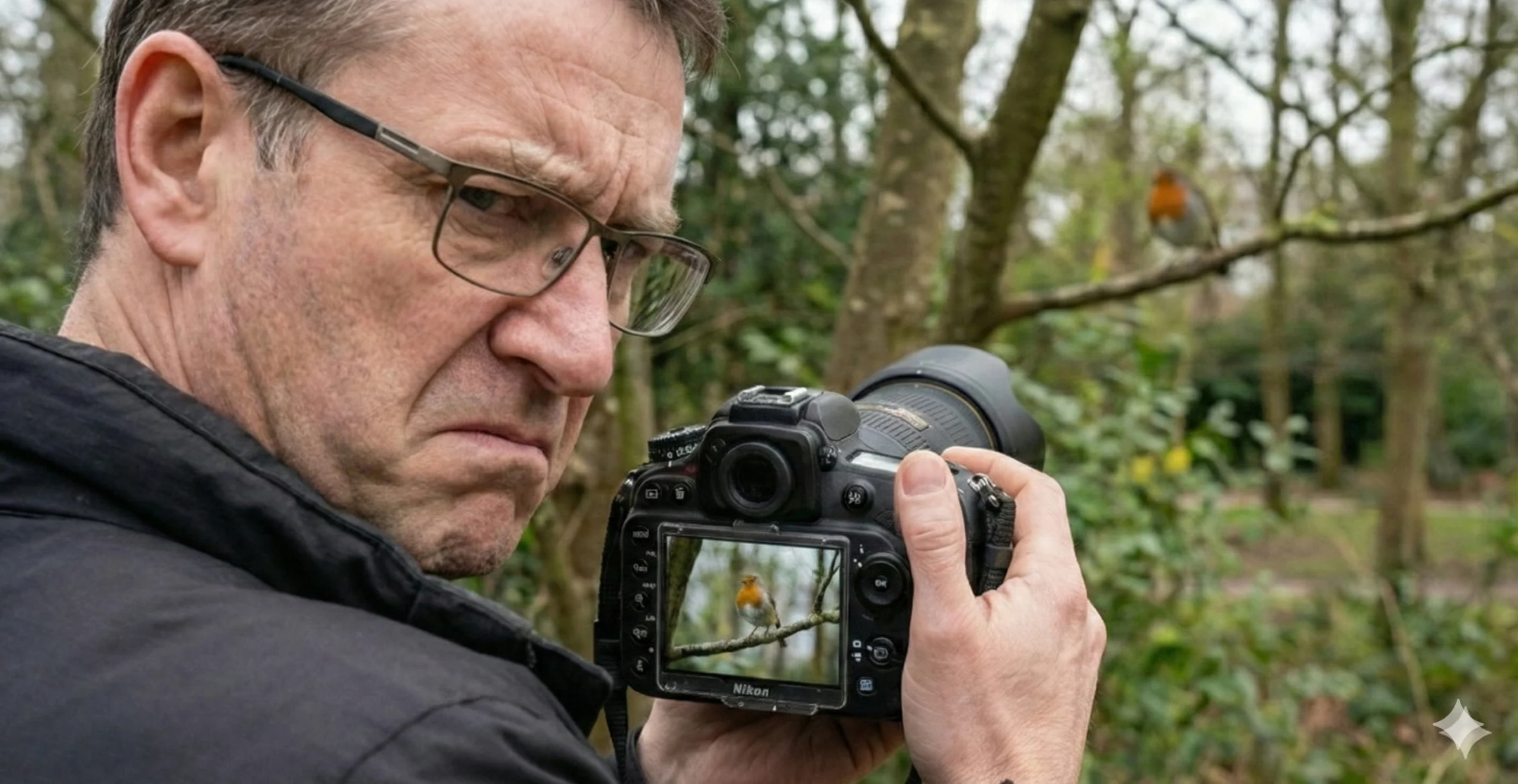
If you’ve ever reviewed an image on the back of your camera and thought, “Why isn’t that sharp?”, you’re not alone. Photographers regularly experience soft or inconsistent focus, even when using high‑end cameras, premium lenses and good technique.
At Camercalservices we specialise in identifying and correcting these focus issues. We’ve calibrated well over 9,000 lens and camera combinations, building a unique real‑world dataset of how different brands and models behave. This article explains what really causes front‑ and back‑focus, why calibration is so important for DSLR and Nikon Z mirrorless users (especially when using adapted F‑mount lenses), and how we diagnose and correct problems using both in‑camera tools and manufacturer‑specific systems such as Sigma and Tamron USB docks.
Who Benefits Most from Calibration?
While all interchangeable‑lens systems can benefit from calibration, it is especially important for:
- DSLR users (Canon & Nikon) who rely on a separate phase‑detect AF sensor in the mirror box.
- Nikon Z mirrorless users using F‑mount lenses via the FTZ adapter.
- Wildlife and sports photographers using long telephoto zooms and primes.
- Portrait and wedding photographers working at wide apertures where depth of field is extremely shallow.
- Macro photographers, where even a few millimetres of front‑ or back‑focus is obvious.
We strongly recommend calibration for users of DSLRs and Nikon Z mirrorless systems, particularly when using older F‑mount lenses via the FTZ adapter.
Why Focus Errors Occur – Tolerances & Optical Misalignment
All lenses – whether Canon, Nikon, Sigma, Tamron or others – are built to manufacturing tolerances. Even brand‑new lenses can vary slightly from the ideal optical design. In real‑world terms, that means one copy may naturally focus slightly in front of or behind the intended plane compared to another copy of exactly the same model.
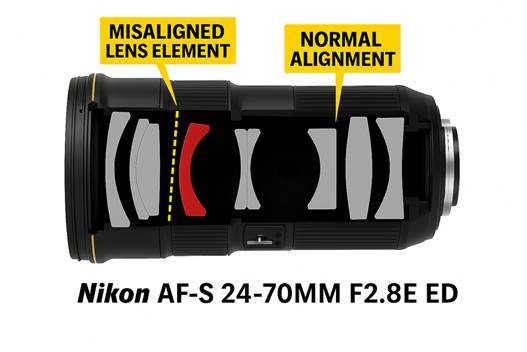
On top of this, lenses are mechanical devices that live a hard life. Small knocks, impacts, repeated travel and zoom/focus wear can cause tiny shifts in internal elements. These shifts are often invisible to the eye, but they are large enough to push the plane of sharp focus forward or backward.
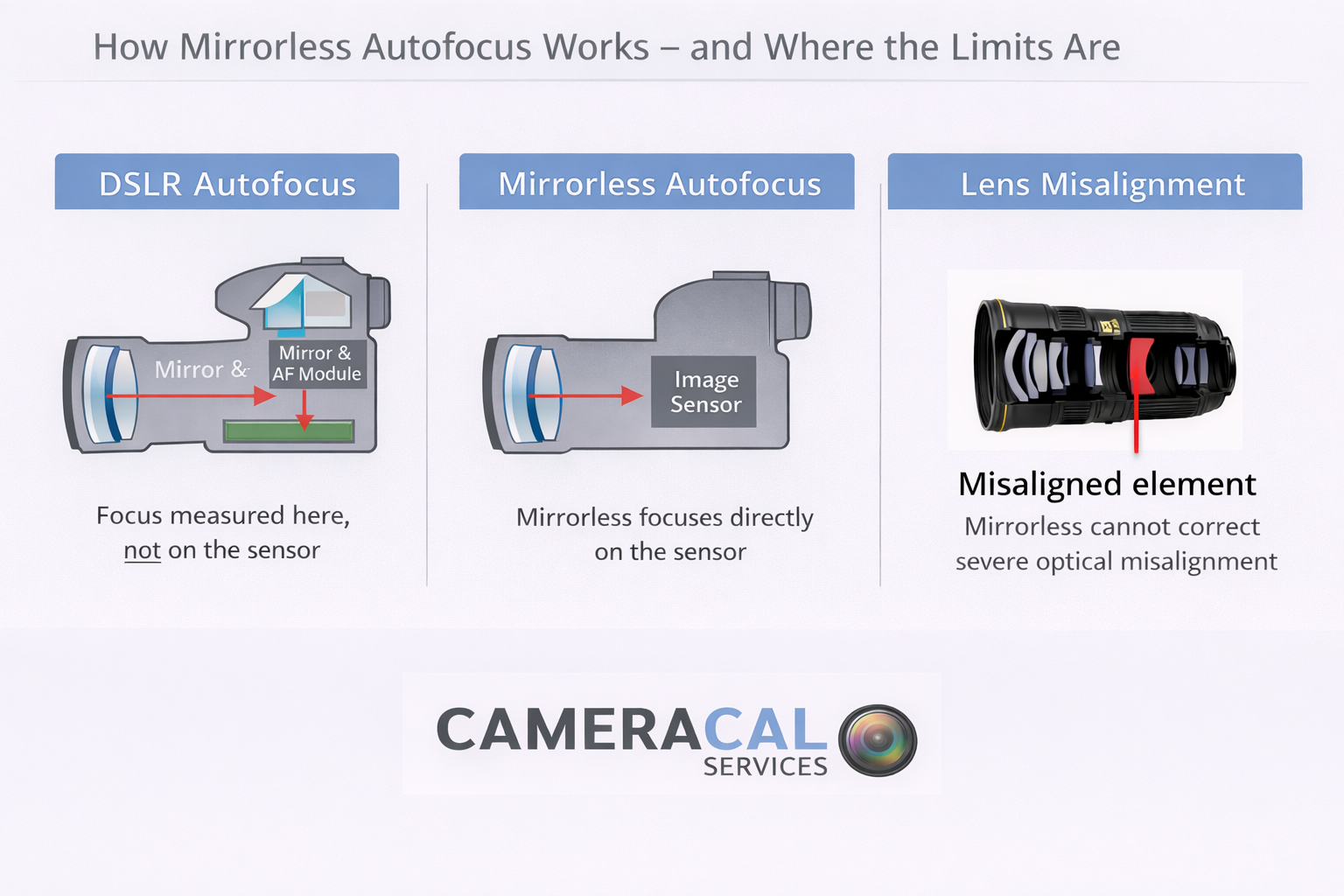
DSLRs introduce another variable: the autofocus (AF) sensor is a separate physical component located in the bottom of the mirror box. If that AF sensor is even slightly mis‑positioned, every lens mounted to the camera will focus off‑plane, regardless of image quality in Live View.
- From our database of over 9,000 calibrations, we see a very consistent pattern:
Approximately 80% of focus problems originate from the lens (tolerances or element displacement). - Around 20% originate from AF sensor displacement or alignment issues in the camera body.
The diagram below illustrates how a displaced lens element can cause focus errors even when the camera body is perfectly within tolerance:
Micro‑Adjustments – The Hidden Calibration Controls
To compensate for these tolerances, many cameras offer an in‑camera calibration feature:
- Canon: AF Microadjustment.
- Nikon: AF Fine‑Tune.
These allow small corrections to be applied on a per‑lens basis so that the camera’s AF system and the lens’s optical system are brought into alignment.
Manufacturers rarely publicise these features – and they almost never explain what a single micro‑adjustment unit actually represents. Through extensive controlled testing at Cameracal Services we have established that, in practical real‑world terms:
1 micro‑adjustment step ≈ 0.75 cm of focus shift at typical calibration distances.
In other words, a correction of ±10 micro‑adjustments can represent a shift of roughly 7.5 cm in the plane of focus – easily enough to move sharpness from a subject’s eyes to their ears, or from near feathers to background grass on a telephoto wildlife shot.
Out‑of‑Box Manufacturing Tolerances – What We Actually See
Based on our calibration database, the typical worst‑case out‑of‑box manufacturing tolerances we see are:
– Canon EF lenses: typically within ±5 micro‑adjustments.
– Nikon F‑mount lenses: typically within ±10 micro‑adjustments.
– Sigma & Tamron lenses: in some cases up to ±15 micro‑adjustments (these third‑party lenses show the widest range in our real‑world testing).
These figures represent the upper end of what we have observed from new equipment – many lenses are better than this, but these values are realistic ‘worst‑case’ tolerances straight from the box.
Canon and Nikon bodies typically provide a ±20 micro‑adjustment range, which is sufficient to correct even these extreme outliers as long as the lens and body are mechanically sound.
Canon AF Microadjustment – Wide and Telephoto End Behaviour
Zoom lenses are rarely perfectly consistent across their entire focal range. It is very common for a zoom to require one correction value at the short end and a different value at the long end.
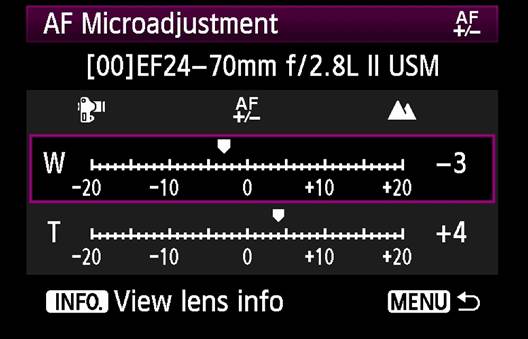
Canon recognised this and, starting with the EOS 7D Mark II and EOS 5D Mark III models introduced the ability to store separate AF Microadjustment values for the wide (W) and telephoto (T) ends of supported zoom lenses. Earlier Canon models only allowed a single global value to be stored per lens, which meant one end of the zoom range could never be perfectly optimised if the lens required different corrections at each end.
Example of Canon’s AF Microadjustment menu allowing separate Wide and Tele values:
One of the most frequently calibrated lenses we see is the Canon EF 100–400mm f/4.5–5.6L IS II USM. Across many copies, this lens has proved to be one of the most consistent performers in the EF range. Typical calibration values we encounter are around −2 micro‑adjustment at 100mm and +2 at 400mm.
This level of consistency is unusual for a zoom with such a long focal range and is an excellent example of how repeat calibration data allows us to understand lens behaviour in a way that spec sheets never reveal.
It also reinforces why zoom lenses should not be calibrated with a single value. A correction that is perfect at the wide end may be noticeably off at the long end, and vice versa.
Nikon AF Fine‑Tune – DSLRs and Z‑Series Mirrorless
Nikon’s AF Fine‑Tune system serves the same purpose as Canon’s AF Microadjustment, allowing per‑lens corrections to be stored in the camera. Historically, Nikon DSLRs only allowed a single AF Fine‑Tune value per lens, but with the introduction of the D780 – and continuing through all Nikon Z‑series mirrorless cameras – Nikon added the ability to store separate values for the wide and telephoto ends of supported zooms.
All Nikon Z mirrorless models support AF Fine‑Tune. This is significant because, unlike most other mirrorless manufacturers, Nikon’s Z‑system employs a hybrid AF design where fine‑tuning can still make a measurable difference, particularly with fast lenses and adapted F‑mount glass.
Example of Nikon AF Fine‑Tune menu used to apply calibrated values:
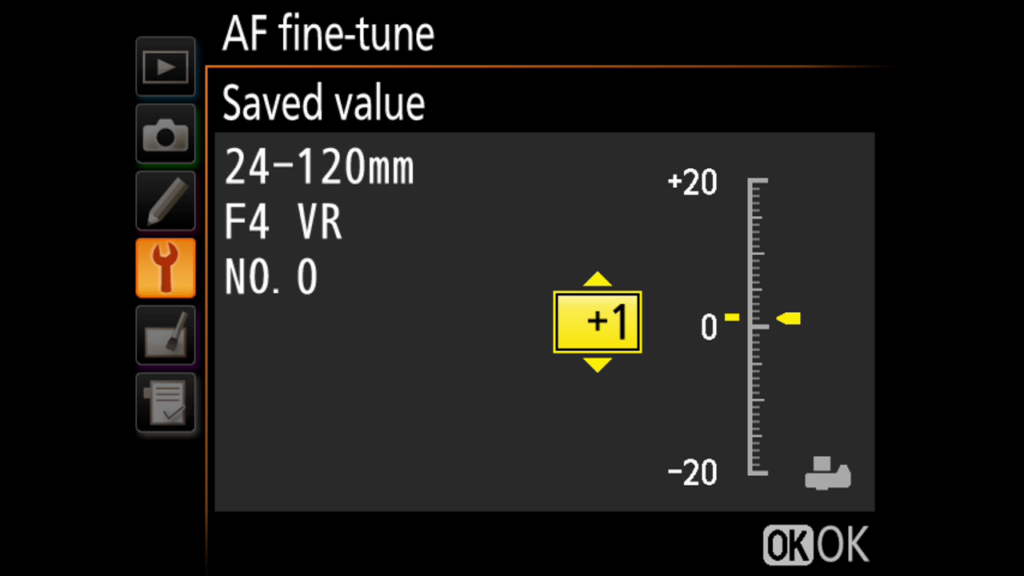
A good practical example is the Nikon AF‑S 24–70mm f/2.8, a workhorse lens for many wedding and event photographers. It often requires different corrections at 24mm and 70mm. In these cases we typically prioritise the 70mm value, as shallow depth of field at longer focal lengths is far less forgiving. At 24mm, increased depth of field – or stopping down slightly – will usually mask any small residual error.
The same principle applies to longer telephoto zooms such as the Nikon 70–200mm f/2.8. These lenses commonly require different values at each end of the zoom range, and having the ability to store separate wide and tele values in the body is a major advantage.
Sigma & Tamron USB Docks – Multi‑Point Lens Calibration
In addition, both Sigma and Tamron have their own advanced calibration systems using USB connectivity – Sigma Optimization Pro with the USB Dock, and the Tamron TAP‑in Console.
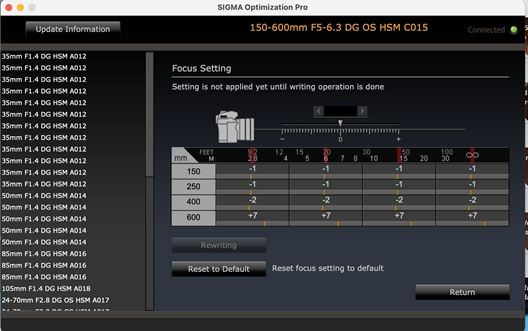
These systems allow users to calibrate focus at multiple focal lengths and multiple subject distances, with the resulting corrections written directly into the lens firmware. Depending on the lens model, this can mean up to 16 independent calibration points (for example, four focal lengths each with four distance ranges).
It is important to note that, although the corrections are stored in the lens, they are still body‑specific. A lens calibrated on one DSLR body may require different values when mounted on another, due to small differences in AF sensor position between bodies.
Example of Sigma Optimization Pro showing multi‑point calibration across focal lengths and distances:
Mirrorless Systems – Improved, But Not Immune
Modern mirrorless lenses and bodies – particularly Canon RF and Nikon Z – generally exhibit tighter manufacturing tolerances than older DSLR systems. However, they are not immune to focus‑related issues, especially when lenses have suffered knocks, drops or internal element shift.
Nikon Z stands apart in that all Z‑series bodies support AF Fine‑Tune, allowing user‑applied corrections much like Nikon DSLRs.
Other mirrorless systems (including Canon RF, Sony, Fuji and Panasonic) rely solely on on‑sensor AF. This design can compensate for a limited amount of optical misalignment – roughly equivalent to around ±8 micro‑adjustment steps – but beyond that range no further correction is possible in‑camera.
We have seen situations where Canon R‑series users experience focus problems when using older EF lenses via the EF‑to‑RF adapter, or even with some RF lenses that sit outside this built‑in tolerance window, particularly if the lens has been impacted. In such cases, when the required correction exceeds what the system can compensate for, there is no user‑level solution and the lens must be returned to the manufacturer for assessment or repair.
Diagnosis – Using Data, Not Guesswork
Accurately assessing whether a lens and body combination can be corrected in‑house – or needs to go back to the manufacturer – requires more than just looking at a few test shots.
At Cameracal Services, we use industry leading solution developed by Reikan. Their FoCal software is used to diagnose and correct these front/back focus issues using data‑driven decisions:
We will soon be introducing our own Focus Analysis software solution to initially diagnose and correct any reported issues using Reikan’s Focal. In essence, the perfect diagnostic and correction tools. Combined these solutions used together allow us to measure whether a particular lens/body pairing is inside or outside the correctable range.
- We can determine whether AF Fine‑Tune / Microadjustment will be effective or whether an optical or mechanical repair is required.
- We generate reports that can be used as evidence when returning equipment to manufacturers or dealers.
This approach removes the guesswork. Instead of “it looks a bit soft”, you receive clear, quantified information and, where possible, calibrated corrections applied to your equipment.
Professional Calibration Partner – Reikan FoCal
As mentioned, we partner with Reikan, developers of the FoCal autofocus calibration and analysis system. FoCal allows us to run highly repeatable autofocus tests, analyse performance, and document the results as part of your calibration report.
FoCal’s large aggregated dataset shows that a significant proportion of cameras benefit from calibration. Their analysis indicates that a clear majority of Canon and Nikon DSLRs show measurable improvement after tuning, and even mirrorless systems can benefit – particularly when using adapted legacy lenses or when lenses are near the edge of acceptable tolerance.
By combining FoCal data with our own extensive calibration experience, we can offer one of the most comprehensive calibration services available in the UK.
What to Expect from a Cameracal Services Calibration.
When you book a calibration with Cameracal Services, we:
- Inspect your camera and lens(es) for obvious mechanical or optical issues.
- Run controlled calibration tests at appropriate focal lengths and distances.
- Apply corrections via AF Microadjustment / AF Fine‑Tune or, where applicable, via Sigma/Tamron dock calibration.
- Verify the results with before‑and‑after comparisons.
- Provide a written report summarising findings, applied values and any recommendations.
In many cases, calibration transforms the consistency and reliability of your autofocus. Even when no user‑level correction is possible, the diagnostic process still provides clarity: you know whether a lens needs to go back to the manufacturer, rather than continuing to fight with soft images and uncertainty.
If you’d like to get the very best out of your camera and lenses – particularly if you shoot fast primes, long telephotos, or rely on critical focus for paid work – we’d strongly recommend having your equipment assessed and calibrated.
To arrange a calibration or discuss your specific setup, please contact Cameracal Services via our website.