A technical white paper produced by Cameracal Services.
1. Introduction
Mirrorless cameras have significantly improved autofocus accuracy by measuring focus directly at the imaging sensor. This removes the traditional DSLR issue of mirror-box autofocus alignment errors. However, mirrorless autofocus does not eliminate every potential source of focus error. Lens-side mechanical or optical issues can still produce systematic focus offsets and image sharpness inconsistencies.
2. DSLR Autofocus vs Mirrorless Autofocus
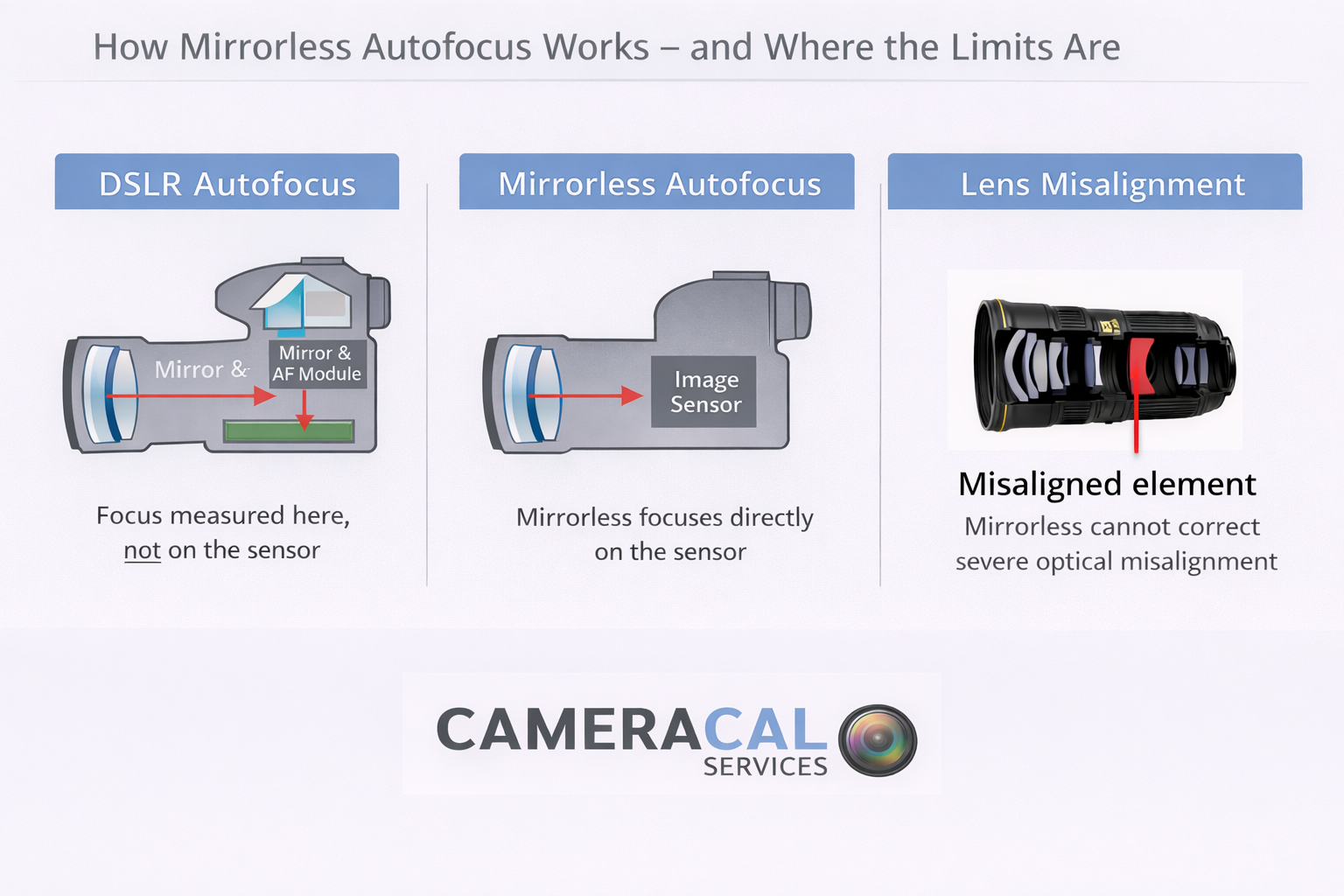
DSLR cameras typically use a dedicated phase-detect autofocus module located within the mirror box. Because this module is physically separate from the imaging sensor, small alignment tolerances between the mirror, sub-mirror, AF module and sensor plane can introduce systematic front- or back-focus errors.
To compensate for these tolerances, many DSLR cameras provide AF Microadjustment (AFMA), allowing the user to apply a correction value for specific lens and body combinations.
Mirrorless cameras measure focus directly at the imaging sensor using on-sensor phase detection (often combined with contrast detection). Because the focusing measurement occurs at the imaging plane, mirror-box alignment errors are eliminated.
3. On‑Sensor Autofocus Correction Capability
Manufacturers do not publish AFMA‑equivalent numeric limits for on‑sensor autofocus correction. Based on internal testing undertaken by Cameracal Services across multiple systems, on‑sensor autofocus can typically compensate for small, stable focus offsets broadly equivalent to approximately ±8–10 DSLR AFMA units.
However, this correction effectively occurs within a single optical plane. Mirrorless autofocus systems can compensate for certain focus offsets because focus is measured directly on the imaging sensor, and the camera can drive the lens to the correct focus position where a consistent error exists.
More complex optical issues, such as decentered elements, tilted optical groups, or displacement caused by impact damage, cannot be corrected electronically. In such situations, the autofocus system may still achieve focus at a single point but image sharpness across the frame may remain inconsistent.
4. Manufacturer Approaches to Calibration
Nikon Z System
Nikon Z‑series mirrorless cameras provide an AF Fine‑Tune function that allows electronic calibration to be applied where systematic focus offsets occur. This is particularly useful when using adapted F‑mount lenses via the FTZ adapter, although calibration may occasionally be required with native Z‑mount lenses.
OM System (formerly Olympus)
OM System mirrorless bodies also provide autofocus calibration functionality, allowing adjustment across multiple autofocus points rather than a single global offset. In practice, however, the need for such calibration appears extremely rare within the OM System ecosystem.
Based on industry discussions with calibration software developer Reikan, requests relating to autofocus calibration within the OM System platform are minimal. This aligns with the experience of Cameracal Services where requests for Olympus / OM System calibration are extremely uncommon.
Canon and Sony Mirrorless Systems
Many Canon and Sony mirrorless cameras do not provide user‑accessible autofocus calibration. In these systems diagnostic analysis becomes particularly important in determining whether observed behaviour originates from normal autofocus tolerance, lens condition, or mechanical misalignment.
5. Calibration Methodology and Tools
Accurate autofocus calibration is difficult to perform reliably by eye. Cameracal Services primarily uses Reikan FoCal software as its autofocus analysis and calibration platform, enabling objective measurement of autofocus accuracy and consistency across supported camera and lens combinations.
Reikan FoCal uses algorithmic image analysis to detect front‑ or back‑focus behaviour and calculate the appropriate autofocus micro‑adjustment value.
FoCal can also be used with certain mirrorless systems. Nikon Z cameras that support AF Fine‑Tune allow FoCal to analyse focus behaviour and calculate the appropriate calibration value in a similar manner to DSLR autofocus micro‑adjustment.
Where mirrorless systems do not provide user‑accessible calibration, FoCal can still be used as a diagnostic tool to evaluate autofocus accuracy and consistency and determine whether a lens is performing within expected tolerances.
6. Example Diagnostic Case: Nikon Z System
A Cameracal Services client using a Nikon Z body with a NIKKOR Z 24‑70mm f/2.8 lens reported difficulty achieving consistent sharpness and had resorted to focus stacking multiple images.
Using Reikan FoCal analysis, Cameracal Services determined that the lens required an AF Fine‑Tune correction value of −19. After applying the calculated value, autofocus performance returned to expected levels and images became consistently sharp.
Further inspection suggested that the lens had likely sustained a minor impact resulting in slight displacement of the internal optical group. In this case the Nikon AF Fine‑Tune function allowed the focus offset to be corrected electronically.
This example illustrates that although mirrorless autofocus is extremely accurate, lens‑side mechanical factors can still introduce systematic focus offsets.
Further reading: https://www.reikanfocal.com/why-nikon-mirrorless.html
7. Practical Guidance for Photographers
If autofocus performance appears inconsistent the following steps are recommended:
• Confirm technique, shutter speed and autofocus mode.
• Test in controlled lighting using single‑point autofocus.
• Compare autofocus results with magnified manual focus.
• Check for asymmetrical sharpness across the frame.
• Consider professional diagnostic analysis where appropriate.
8. Conclusion
Mirrorless cameras have significantly improved autofocus accuracy by measuring focus directly at the imaging sensor, eliminating the traditional DSLR issue of mirror‑box autofocus alignment.
However, mirrorless autofocus does not remove all potential sources of focus error. Lens‑side mechanical or optical factors can still introduce systematic focus offsets.
Where calibration tools are available, such as Nikon Z AF Fine‑Tune, these offsets can often be measured and corrected electronically. In other mirrorless systems where user calibration is not provided, diagnostic testing remains valuable.
Professional analysis tools such as Reikan FoCal — used as the primary autofocus calibration platform by Cameracal Services — allow focus behaviour to be measured objectively and repeatably, ensuring calibration decisions are based on measurable data rather than visual estimation.